
Why Won't My Car Start on Cold Mornings? How to Read a Battery Test Before It Happens — What Longmont Drivers Should Know
It's the first truly cold morning of the season. Frost on the windshield, breath fogging in the driveway, coffee in one hand and keys in the other. You turn the key on your way out to Hover St—and instead of a quick start, you get a slow, groaning "rrr…rrr…rrr" or, worse, a single click.
Here's the frustrating part: that battery probably gave you plenty of warning. It just didn't give it to you on the dashboard. It showed up on a battery tester.
At Christian Brothers Automotive Longmont, local owners Josh and Lindsy Jeanneret ground our whole shop culture in "The Nice Difference"—and that means showing you the real proof, not asking you to take our word for it. So this week, we're doing something a little different. We're pulling two real battery tests from our bays at 110 East Ken Pratt Blvd and showing you exactly how our ASE-certified techs—Tyler, Joe, and Alex—read them.
Two Real Batteries, Two Very Different Stories
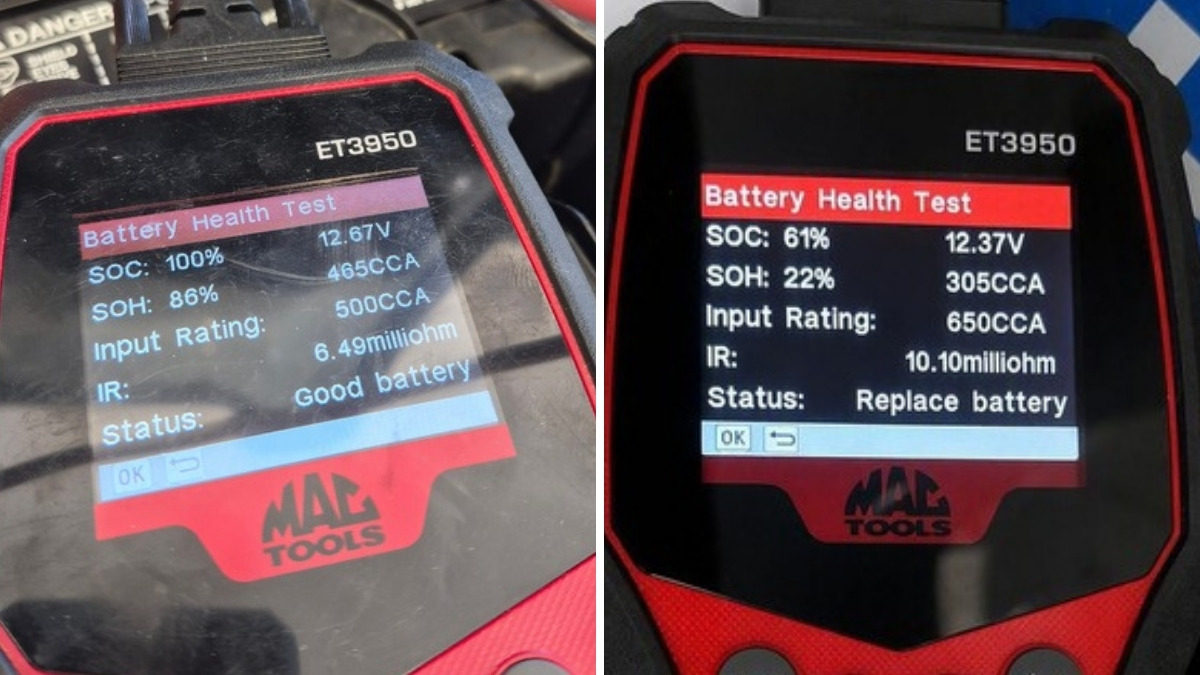
Battery #1 — "Good battery"
- State of Charge (SOC): 100%
- State of Health (SOH): 86%
- Measured: 465 CCA (rated for 500 CCA)
- Internal Resistance: 6.49 milliohms
- Verdict: Good battery
Battery #2 — "Replace battery"
- State of Charge (SOC): 61%
- State of Health (SOH): 22%
- Measured: 305 CCA (rated for 650 CCA)
- Internal Resistance: 10.10 milliohms
- Verdict: Replace battery
Both of these batteries came off real vehicles. Here's what every one of those numbers means for your family's morning.
1. What Are Cold Cranking Amps (CCA)?
Look at the label on top of your battery and you'll usually see a number followed by "CCA." That's its Cold Cranking Amps rating—the industry measurement of how much current a fully charged 12-volt battery can deliver at 0°F for 30 seconds while still holding at least 7.2 volts.
In plain English: CCA is how hard your battery can push to turn over a cold engine.
That matters here along the Front Range because cold mornings hit your battery twice. The cold slows down the chemical reaction inside the battery, so less power is available—and at the exact same time, cold engine oil is thicker, so your starter needs more power to crank. Less supply, more demand.
Battery #1 was rated for 500 CCA and still delivered 465. Plenty of margin.
Battery #2 was rated for 650 CCA and could only deliver 305—less than half of what it was built for. That's a battery one hard cold snap away from leaving someone stranded.
2. "Charge" and "Health" Are NOT the Same Thing
This is the part that surprises most drivers.
State of Charge (SOC) is how full the battery is right now—like the fuel gauge on your dash.
State of Health (SOH) is how much of the battery's original capability is left—like the size of the gas tank itself.
Look at Battery #2 again: it was 61% charged, but only 22% healthy. You could charge that battery all the way to 100% overnight, and it still wouldn't have the strength to be trusted on a January morning. Charging fills the tank. It can't make the tank bigger again.
That's why "It started fine this morning" and "It just needs a charge" can both be true—and the battery can still be failing.
3. Internal Resistance: The Number That Quietly Climbs
As a battery ages, its internal resistance rises. The higher that number, the harder it is for the battery to deliver current when your starter demands it.
Battery #1: 6.49 milliohms. Battery #2: 10.10 milliohms.
You'll never feel that difference on a warm afternoon on Ken Pratt Blvd. You'll feel it on the first 20-degree morning.
4. A Jump Start Gets You Moving—It Doesn't Fix Anything
If your car won't start on a cold morning, a jump start can absolutely get you to work. But it doesn't repair a battery with 22% health, and your alternator is designed to keep a healthy battery topped off—not to nurse a worn-out one back to life on your drive down Highway 119.
If you've needed a jump, that's your cue to have the battery and charging system tested—not a problem solved.
A few smart habits for a no-start morning:
- Crank in short bursts and give it a minute between tries instead of grinding the starter.
- Turn off the headlights, heater fan, and accessories before you try again.
- If it clicks but won't crank, stop and call us—repeated attempts won't fix a dead battery and can strain the starter.
5. Why the Right Replacement Battery Matters
Not every battery is created equal, and not every vehicle takes the same type.
Many newer vehicles—especially ones with automatic start-stop (the engine shuts off at red lights on Ken Pratt and restarts when you lift off the brake)—come from the factory with AGM or enhanced flooded batteries designed for those repeated restarts. Swapping in the wrong type can shorten battery life and cause electrical headaches. Some vehicles also need the new battery registered to the vehicle's charging system after installation.
That's why our techs match the battery to your vehicle's exact specifications—type, size, and CCA rating—rather than grabbing whatever's on the shelf.
6. The "Longmont Factor": Why This Hits Now
Our batteries take a beating in northern Colorado:
- Big overnight swings—a 75-degree afternoon followed by a frosty 30-degree morning
- Vehicles parked outside in driveways and lots instead of a warm garage
- Short hops around town that never give the alternator time to fully recharge
- Cars left sitting for a week in the long-term lot at DIA over the holidays or during a ski trip, while modern electronics slowly draw power even with the key off
As we covered in our summer battery article, heat creates much of the damage. The first cold mornings of fall are when that damage finally shows up.
See the Test Yourself—Texted Straight to Your Phone
At our clean shop at 110 East Ken Pratt Blvd, we don't replace batteries just because they're a few years old, and we don't guess. During our Digital Vehicle Inspection (DVI), our techs hook a professional battery tester to your battery, measure its actual cold cranking amps, state of health, and internal resistance. Then we text a photo of the real test screen straight to your smartphone—just like the two results above—so you see exactly what we see before you decide anything.
And here's the best part: battery testing is always FREE at our shop. It's also included in the courtesy inspection that comes free with any service—so if your vehicle is in for an oil change or any other work, your battery gets checked too.
The Nice Difference Experience:
- Transparent Results: Healthy, weakening, or failing—you see the numbers and stay in complete control of your budget.
- Zero Disruption: Drop your car off with Bryan, Josh, Mark, or Bob at the front counter and ride home or to work on our Local Courtesy Shuttle.
- Nationwide Peace of Mind: Qualifying repairs are backed by our industry-leading 3-year/36,000-mile nationwide warranty (whichever comes last).
Don't let the first cold morning of the season make the decision for you. Call Josh, Lindsy, and the team today at 720-605-0932 for a free battery test, or book online at scheduler.cbac.com/longmont!
[1].jpg "Four Common Services Offered at Auto Repair Centers")
[2].jpg "Make Sure You're Getting Quality Auto Parts")
sunwash-tech-with-customer.png "What is a Car Inspection?")