Do I Need Winter Tires in Colorado? All-Season vs. All-Weather vs. Winter Tires Explained
September in Longmont is a total seasonal mood swing. One afternoon you’re cruising down Ken Pratt Blvd with the windows rolled down, and a few mornings later, you’re scraping thick frost off your windshield before hopping onto Main St.
As the autumn air crispens, our front desk team—Bryan, Josh, Mark, and Bob—starts getting the exact same question from local drivers:
👉 “Do I actually need dedicated winter tires this year, or can my current set handle Front Range weather?”
Before you spend a single dollar, there’s a massive tire distinction many drivers overlook: All-Season tires and All-Weather tires are NOT the same thing.
Depending on whether your daily commute stays in town or you frequently haul the family up toward Estes Park or along I-70, that difference is critical. Local owners Josh and Lindsy want to make sure you have the exact facts to keep your household safe and budget intact. Here is how our ASE-certified technicians—Tyler, Joe, and Alex—break down your options.
1. What Is a Traditional "All-Season" Tire?
The name sounds like an all-inclusive guarantee, but "all-season" is a bit of a misnomer in Colorado.
Standard all-season tires are engineered to balance dry pavement handling, wet road traction, quiet ride comfort, and long tread life in mild climates. However, once ambient temperatures drop below 45°F, the rubber compound in a traditional all-season tire hardens like a hockey puck. That stiffening dramatically reduces your rubber's ability to grip cold asphalt, slush, or hard-packed snow.
For mild climates, they are great year-round performers. For a freezing January morning on Hover St, they leave a lot to be desired when you need to stop in a hurry.
2. What Is an "All-Weather" Tire? (The Front Range Sweet Spot)
This is the tire category more Longmont drivers need to know about.
An all-weather tire is built to stay on your vehicle 365 days a year like an all-season, but its rubber compound is specially engineered to remain flexible in sub-freezing temperatures.
To spot a true all-weather tire, look at the sidewall for the Three-Peak Mountain Snowflake icon—a severe snow service rating depicting a snowflake inside a three-peaked mountain outline. This symbol proves the tire passed standardized, rigorous acceleration testing on packed snow.
For drivers who want legitimate snow capability without the hassle of storing and swapping a second set of wheels every spring, all-weather tires offer a fantastic middle ground.
3. What Makes a Dedicated Winter Tire Superior on Ice?
Dedicated winter tires (like Bridgestone Blizzaks) take cold-weather traction to the maximum level. They feature:
- Hyper-Flexible Compounds: Silica-infused rubber that stays soft and sticky even in sub-zero freezes.
- Deep Tread Grooves & Sipes: Thousands of microscopic razor-thin slits (siping) in the tread blocks that bite directly into packed snow and ice.
The Tradeoff: Winter tires are not designed for warm summer pavement. If you leave them on your vehicle through a hot July on Ken Pratt Blvd, the soft rubber compound will squirm and wear out rapidly.
4. "M+S" vs. "3PMSF": Don't Be Fooled by Sidewall Stamps
Many drivers check their tires, see an "M+S" (Mud and Snow) stamp, and assume they are fully rated for severe winter storms.
Here is the truth: The M+S designation is an old geometry rating based purely on tread block spacing. It requires zero actual cold-weather or snow-traction testing. The Three-Peak Mountain Snowflake (3PMSF) symbol, on the other hand, guarantees proven snow performance. Don't treat M+S and 3PMSF as interchangeable when prepping for a Front Range blizzard.
5. Which Tire Matches Your Longmont Driving Routine?
There is no single "right" tire for every household. Your choice should match your actual driving habits:
- The Front Range Commuter: If 95% of your driving stays between Longmont, Boulder, and Denver, a quality All-Weather tire with the 3PMSF rating provides outstanding year-round peace of mind.
- The Foothills & Canyon Driver: If you make frequent trips up to Estes Park or live in higher elevation neighborhoods, an All-Weather or dedicated Winter tire becomes essential.
- The I-70 Ski Warrior: If your weekends involve heading west past Morrison to hit the slopes every storm cycle, a set of dedicated Winter tires is the safest, smartest investment you can make.
6. Understanding Colorado's Traction Law (I-70 Corridor)
If you drive into the mountains, having the right tires isn't just about safety—it's state law.
From September 1 through May 31, Colorado’s Passenger Vehicle Traction Law is automatically active on I-70 between Morrison and Dotsero. To legally drive this corridor during winter, all passenger vehicles must have:
- An AWD/4WD vehicle with at least 3/16-inch tread depth, OR
- A 2WD vehicle equipped with 3PMSF winter/all-weather tires (or M+S tires) with at least 3/16-inch tread depth, OR
- Approved traction devices (like tire chains or AutoSocks).
Fines for blocking traffic during a traction law enforcement event can easily top $650. Knowing your tread depth before heading up Highway 119 is vital.
7. The "AWD Fallacy": AWD Helps You Go, Tires Help You Stop
One of the most dangerous winter driving myths is: "I have All-Wheel Drive, so I don't need winter tires."
AWD transfers engine power to all four wheels to help you accelerate out of a snowbank. However, AWD does absolutely nothing to help you stop or turn on ice. Every single vehicle on the road—whether it's a front-wheel-drive sedan, a heavy 4x4 truck, or a dual-motor EV—relies entirely on four handprint-sized patches of tire rubber to brake and steer.
8. Why Tread Depth Is Non-Negotiable
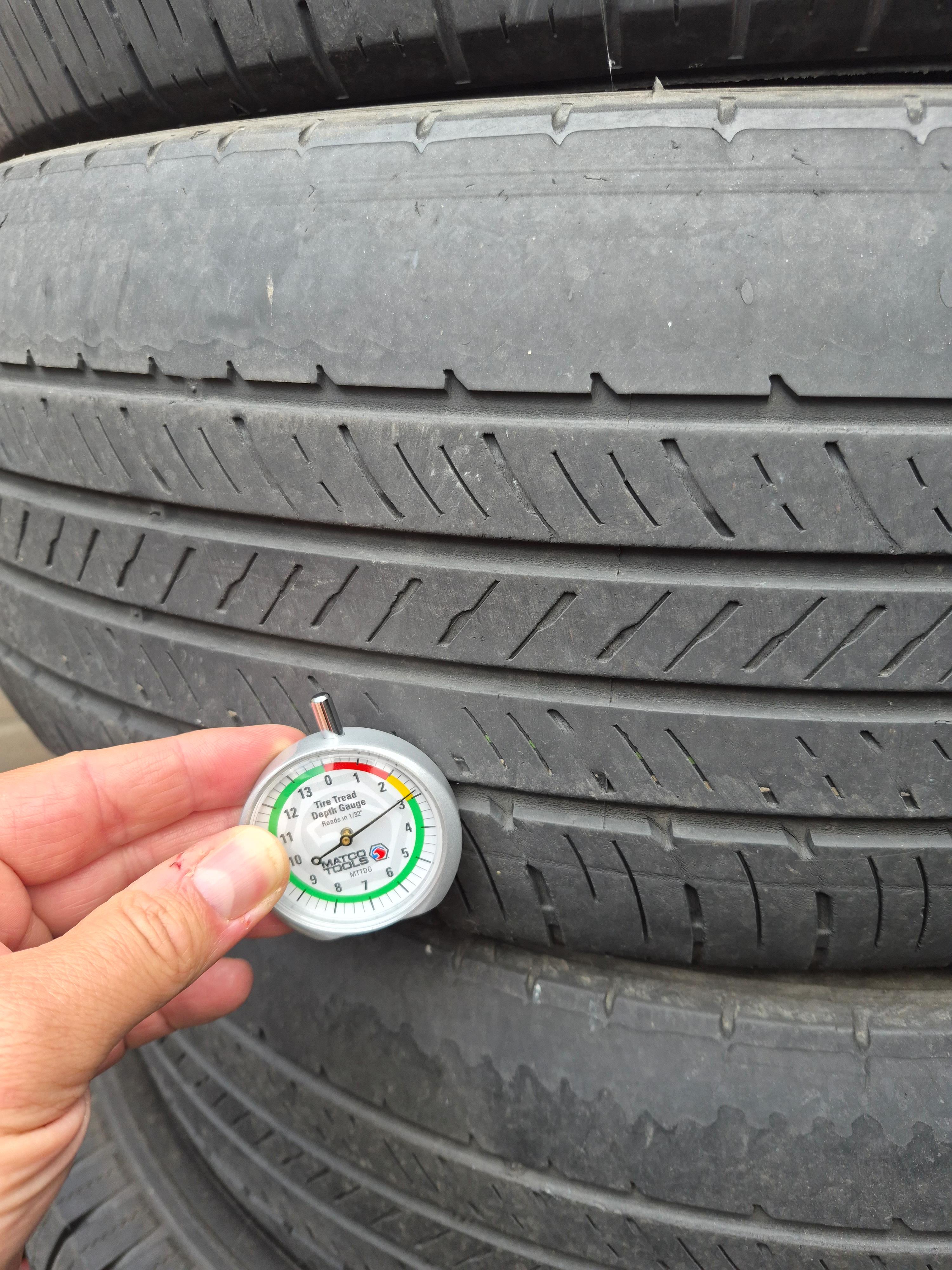
Even the highest-rated winter tire loses its ability to evacuate slush once the tread wears down. Deep channels are required to pump slush away from under the tire footprint to prevent hydroplaning. That is why CDOT enforces a strict 3/16-inch (6/32") minimum tread depth requirement for winter compliance. Early autumn is the ideal time to measure your tread before snow hits.
9. Never Install Winter Tires on Only Two Wheels
If you decide to run dedicated winter tires, install them on all four wheels—period.
Mounting winter tires on only the drive wheels creates a drastic traction imbalance. If you put winter tires on the front of a front-wheel-drive car but leave all-seasons on the back, the rear tires will lose grip in a turn, causing the back end of your car to fishtail uncontrollably. Treat your tires as an integrated four-wheel safety system.
Transparent Visual Proof at CBA Longmont
At our shop at 110 East Ken Pratt Blvd, we don't believe in guessing or recommending unnecessary tire sales.
During every service visit, Tyler, Joe, or Alex uses digital depth gauges to measure your exact tire tread across the inner, center, and outer tread blocks. Through our Digital Vehicle Inspection (DVI), we take clear, high-resolution photos of your tread depths, sidewall stamps, and wear patterns, texting the complete report directly to your smartphone.
You see the exact physical evidence of your tires’ condition before making any decisions.
The Nice Difference Experience:
- Zero Disruption: Drop your vehicle off and take our clean Local Courtesy Shuttle back home or to work so your day stays on track.
- Unbeatable Warranty: Any qualifying mechanical or suspension work we perform alongside your tire service is backed by our industry-leading 3-year/36,000-mile nationwide warranty (whichever comes last).
[1].jpg "Four Common Services Offered at Auto Repair Centers")
[2].jpg "Make Sure You're Getting Quality Auto Parts")
sunwash-tech-with-customer.png "What is a Car Inspection?")